Transcript: Jamie McMurray and Scott Dixon Swap Rides For Tours of Barber Motorsports Park and Talladega Superspeedway

TALLADEGA, Ala. – The worlds of NASCAR and IndyCar came together at Talladega Superspeedway and Barber Motorsports Park today. NASCAR Sprint Cup Series driver Jamie McMurray slid behind the wheel of Scott Dixon’s 09 Target Honda IndyCar at Barber, and Dixon took McMurray’s No. 1 Bass Pro Shops Chevrolet for some hot laps at Talladega.

Dixon, on what he told McMurray about Barber: This is one of our toughest circuits, just because it’s very narrow. It’s quite cold today. There’s a bunch of elevation. Elevation’s a bit of a pain when you can’t see the corners. Jamie’s very accomplished, and has raced many different types of cars. I think the toughest part of an IndyCar is the first couple of laps, in terms of getting up to speed on cold tires.

McMurray, on whether he was going to take it easy at Barber: For me, it’s all about the experience. It’s not about going out and seeing how hard I can drive it, or exactly what the limits are.

McMurray, about getting the chance to drive an IndyCar: When I drove for Chip Ganassi from 2002 to 2005, honestly I don’t think I even saw an IndyCar. Never had the opportunity. When I came back here, I told Chip that if there was ever a chance, I’d really like to drive one of those somewhere. I didn’t really expect all the media and everyone else to be here on my adventure. I was more wanting to go spend half a day with the team somewhere and really get to test, and see what it’s like. But this is a really cool opportunity for me.

Dixon, on how fast an IndyCar could go at Talladega: In this configuration, with the big wings, you’d probably do 170 to 180. But with speedway wings, you’d probably do about 230. Maybe even more than that. Maybe 240 or more.

McMurray, on the car-swapping opportunity: I think it’s cool that the racetracks came together and were able to let us help promote those races and make it fun for us. For me, getting to drive this is a great opportunity. It’s a lot of money to come and do something like this, so it worked out well that they were already here testing. For Chip to bring his car down to Talladega and let Scott drive it, it’s hard to put those two together, because it costs so much money.

Dixon, on the possibility of becoming a Sprint Cup driver: Well, there’s no $5 million prize in NASCAR, so no, I’m not going. (Laughing.) Obviously, I’m intrigued by it. Sprint Cup is a massive sport, and has a huge following. I think the thing that’s most intriguing, as you’ve seen by the people who have tried to make the transition or have made the transition, it’s 43 cars that are very, very tight and very, very close. I think the tough part for me would be actually doing the 36 races a year. That’s a lot of travel.

McMurray, after running at Barber: The Cup cars slide around a lot, and for me, I think that’s probably where the speed is that I didn’t have in this race car. Knowing the threshold of, if it breaks loose, how much you can hang on to it.

The acceleration of that car was way more than I expected, because the horsepower is less than the Cup cars. I thought that the acceleration would be a fair bit less. But that was really fun to drive. I couldn’t believe how quickly the car took off.

I never really pushed it very hard in the corners to get the feel of how much grip it has, for fear that I’d lose my other job if I happened to run off. It’s crazy at the amount of grip that car has.

McMurray, after spinning out at Barber: It was the slowest corner on the track, and I was just trying to go a little quicker. The car wanted to spin the tires really badly right there, and I probably didn’t give it enough time to get the tires warmed up enough. If I had to choose somewhere to spin out there, that was a really good selection, because it didn’t cost anything.

McMurray, on the difficulties of driving an IndyCar: I thought the hardest part was just being in the open, and being exposed without a windshield. But that didn’t bother me at all. I actually enjoyed being out in the open and not having to look through a visor and a windshield. The hardest adjustment was just knowing how hard you can push, and what the limits are of sliding the car. When we run Watkins Glen or Sonoma, the whole race is about sliding around the corners. After spinning out at about 30 mph over there, I was really timid to push the car any harder in the fast corners.

I’m just glad they called me in, because I kept picking up about two seconds a lap. At some point that ends, and you end up dropping a wheel off the track. But I couldn’t believe how much more comfortable I got in the car.

The sensation of speed was more in acceleration and braking. The cornering did not feel that much faster, even though it was. The car had so much grip and so much control that when you’re going around a corner 30 miles per hour faster than you could in a Cup car, I didn’t sense the speed there.

Dixon, after running at Talladega: It was cool. The whole “sitting with a cover over you,” and the seating position, and all the other things that were different in the car, the way the wheel is and how massive it is, all that was fun. This place is massive. I spoke before about how Indy is large as well, but I think the sheer size of this and how it’s spread out, when you go out there, you feel really lonely by yourself. It would have been nice to maybe have a few other cars out here and maybe take the restrictor plate off and see the full power of these kinds of cars on a track like this. I really enjoyed it. It was definitely an eye-opener. It was something I’d love to have a go at again.

Dixon, on getting in and out of a stock car: They’re pretty hard to get in and out of. I will say that. I thought ours would be more difficult, but you just come from the top and slide in. Here, you’ve got to go ‘Dukes of Hazzard’ style and slide through the window.

Dixon, on what was the hardest part of running at Talladega: Going out on the track and running at speed wasn’t the most difficult part, because that’s not the style of racing that they do at Talladega. It’s all about the drafting and the pushing. I’d love to have had a go out there with some other people. Maybe do the tandem thing, and stuff that we’ve been watching in the Cup races.

On having more respect for Cup drivers: I’ve always had a ton of respect for the Cup drivers and what they do. As you can see, nobody steps into that series and sets it on fire. They’re very accomplished guys…In IndyCar, you have teammates and you sit down after every practice and go over data and try to work out where you can improve. To be honest, no data and teammates you don’t get to see a lot because it’s so divided would make the learning curve tough.

Racers Continue To Make History As Bristol Celebrates 50th Anniversary
This season marks the 50th anniversary of Bristol Motor Speedway, a track at which the sport has generated heaps of history – and storylines.

The all-time Bristol wins leader list is practically a one-stop shop for NASCAR history in itself. Eight of the top nine are all series champions, and five of those are either NASCAR Hall of Famers, inductees or nominees. The top nine: Darrell Waltrip (12), Dale Earnhardt (9), Rusty Wallace (9), Cale Yarborough (9), Kurt Busch (5), Jeff Gordon (5), David Pearson (5), Bobby Allison (4) and Kyle Busch (4).

Wood Brothers Bristol Return Sparks Fond Memories
The return to Victory Lane for the legendary Wood Brothers at the Daytona 500 coincides with the 10-year anniversary of it last win before 2011: at Bristol in 2001, with Elliott Sadler.

A couple of Wood Brothers storylines mesh together this weekend. There’s the anniversary on the heels of the Daytona 500 win. But there’s also its driver returning to his hometown track. Trevor Bayne, a Knoxville, Tenn. native returns home to race for the first time since his win in The Great American Race.

2011 Features Some Interesting Comebacks and Slow Starts
Statistically speaking, some drivers are having starkly different seasons this year compared to last.

Some of that might have to do with a wrinkle in the schedule. Last season opened with races at Daytona, Auto Club Speedway and Las Vegas. This season opened with Daytona, Phoenix and Las Vegas.

Still, it’s interesting to see the peaks and valleys. For instance…

Stewart-Haas Racing is having the biggest comeback start. Ryan Newman has had the biggest Driver Rating jump after three races. After three events in 2010, his Driver Rating was 66.1. Currently, Newman has a rating of 101.5, a jump of 35.4 points – the largest gain in the series. Second is Tony Stewart, who improved 30.3 points – from 88.1 in 2010 to a series-best 118.4 now.

The biggest drops are all members of the 2010 Chase for the NASCAR Sprint Cup. The biggest drop is Kevin Harvick, who had a Driver Rating of 116.4 after three races last year. He now has a 73.4, a drop of 43 points. Jimmie Johnson dropped 36.7 points, from 113.0 last year to 76.3 after the first three races this season.

By Jared Turner
Special to the Sporting News NASCAR Wire Service

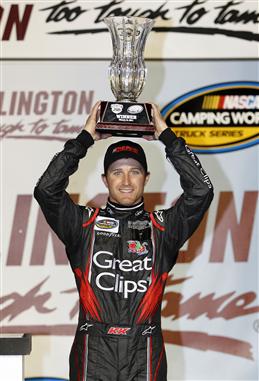
DARLINGTON, S.C.—Kasey Kahne did it again.

Making his first and possibly only Camping World Truck Series start of the year, Kahne cruised to a relatively comfortable win in Saturday’s Too Tough To Tame 200 at Darlington Raceway.

The victory made Kahne the first driver in the truck series to win three of his first four starts.

Second alongside Elliott Sadler on a restart with 53 laps to go, Kahne immediately dispatched of Sadler—who had taken two tires under the previous caution—and never trailed again.

Kahne held on through three more restarts, including a final one with three laps to go, to take the checkered flag ahead of four-time series champion Ron Hornaday Jr. and 2010 Darlington winner Todd Bodine. Matt Crafton and James Buescher completed the top five.

Kahne’s stiffest challenge over the final laps came from Bodine, who once moved alongside before getting loose and falling into the clutches of Hornaday.

“I gave it a shot and got sucked around and got loose and all that and finished third,” Bodine said.

Kahne, a full-time driver in the Sprint Cup Series since, scored truck wins at Darlington and Homestead-Miami Speedway in 2004 and finished second last year at Pocono Raceway.

Saturday marked Kahne’s second appearance in the Kyle Busch Motorsports Toyota normally driven by team owner Kyle Busch, who was vacationing in Cancun.

“This is one of my favorite racetracks,” said Kahne, who qualified second and led four times for 95 of the 147 laps. “I’m really glad I came. I really enjoy driving this thing.”

Matt Crafton remained the series leader, stretching his advantage to six points on rookie Cole Whitt, who moved into second after three races. Whitt finished an impressive eighth after starting from the pole and leading twice for 30 laps before dropping back with a pit-road mistake and engine issue.

Whitt, 19, was making his fourth career truck series start, his first at Darlington.

“The track just kind of suited my driving style, and from the get-go we just kind of fell into the rhythm,” Whitt said.

The race was slowed by 10 cautions, including one for a three-truck wreck involving Johanna Long, Ricky Carmichael and Nelson Piquet Jr. that brought out the red flag for 7 minutes, 37 seconds.

Notes: Kahne’s margin of victory was 1.116 seconds. … Kahne, who started second, became the fourth winner to start inside the top five. Bodine started eighth last year, and Bobby Hamilton started 14th when he won in 2003. … Kahne’s three wins tie Rich Bickle, Andy Houston and Dave Rezendes for 27th on the all-time win list.

If you would have asked Jeff Burton, driver of Richard Childress Racing’s No. 31 Caterpillar Chevrolet in the NASCAR Sprint Cup Series, at the beginning of the 2011 season if he thought the first three races would bring him bad luck, his answer would have been ‘No.’ Same with crew chief Todd Berrier, director of competition Scott Miller and the entire Cat Racing team.

Unfortunately, it did. And, with those three races now in the record books, Burton heads to Bristol Motor Speedway, the site of the fourth race on the 2011 Sprint Cup Series schedule, 32nd in the championship point standings and with one thing on his mind – redemption.

The South Boston, Va., native started off the year with a win in the Duel 150 qualifying race at Daytona International Speedway that secured him and the No. 31 Caterpillar team the fourth starting spot for the 53rd running of the Daytona 500. But, that high soon led to the first of three lows.

After showcasing a strong and fast No. 31 Caterpillar Chevrolet during the first half of the Great American Race and leading a total of five laps on two separate occasions, the engine expired on the RCR entry, forcing the team to call it a day and leave the historic speedway with a 36th-place finish.

The Berrier-led squad, again, produced a fast black and yellow Chevrolet for the 312-lap at Phoenix International Raceway the following weekend, but a wrong place, wrong time circumstance accumulated the veteran driver in a multi-car incident just 60 circuits in. Speedy work by the crew to repair the damaged machine to the best of their abilities sent Burton back on track in order to gain as many valuable positions as he could before the checkered flag waved and, because of that, he was able to salvage a 26th-place result.

Most recently, handling woes and ever-changing track conditions at Las Vegas Motor Speedway got the best of the Cat Racing team that left them leaving Sin City with a 21st-place finish.

Alas, the off weekend – a few days for the driver, crew chief and gang to clear their heads and erase the misfortunes that plagued them early in the season.

“It’s very disappointing to have the finishes that we had in these first three races,” commented Berrier. “Obviously, this isn’t how we pictured our season to start out, but it’s the situation we’re in and we’ll do everything we can to dig ourselves out from underneath it. Our team is strong and we’ll recover. I don’t like losing, so you can believe that we’re doing everything we can to turn this ship around.”

The next four races on the schedule – Bristol Motor Speedway, Auto Club Speedway, Martinsville Speedway and Texas Motor Speedway – couldn’t have come at a better time for the 21-time Sprint Cup Series winner. After all, he has found Victory Lane at three of those four tracks in his career.

In 2008, Burton beat his RCR teammates to the line, claiming his first victory at the Bristol bullring. A third-place finish last year at Auto Club Speedway has the Cat Racing team wanting more when they return to the West Coast and numerous laps led at both Martinsville Speedway events last year has Burton hungry for a win at his home track. And, how can you forget Texas – not only the site of Burton’s first Sprint Cup Series victory, but the Fort Worth facility’s first repeat winner.

“It’s, obviously, disappointing to be where we are in the point standings,” stated Burton. “With as much preparation that we, as a company, did over the off season, it’s something that we couldn’t have done any different. Some of the situations we were involved in were out of our control while some were in our control. I’ve said all along that the new points structure will hurt those with poor finishes and we’re a classic example of that. Yes, we have a hole to dig out of, but that doesn’t mean we can’t do it. I believe in this team, wholeheartedly, and I really believe that over these next few races, you’ll see us have a complete turnaround.”

The boys in black and yellow will head to the World’s Fastest Half Mile next Thursday, looking for that turnaround. An hour-and-a-half practice session commences all Sprint Cup Series activity on Friday followed by qualifying. Then, the Cat Racing team will have two more chances on Saturday to fine tune their No. 31 Caterpillar Chevrolet for Sunday’s 500-lap showdown.