How does a racing sport go from dirt-oval battles between bootleggers and hot rodders to America’s largest and most popular racing series? The rise of NASCAR from its early roots in the Prohibition era to its current position as a multi-million dollar juggernaut with races watched by millions of Americans is a story that’s as suspenseful – and at times colorful – as the Talladega 500.
From Bootlegging to Oval Racing
The sport’s earliest days can be linked not to any race track, but to an activity from the Prohibition era – bootlegging. As Rick Hudson notes in an in-depth look at early NASCAR history, famous NASCAR drivers like Junior Johnson first cut their teeth dodging revenuers in sedans modified to haul as much moonshine as possible, as fast as possible. The sport also had plenty of roots on the sandy shores of Daytona Beach, where promoters like Sig Haugdahl held oval-track races on the firmly packed beach and tarmac.

Photo by Unknown via Wikimedia Commons
The National Association for Stock Car Auto Racing (NASCAR) came about in December 1947, courtesy of Bill France, Sr., then an up-and-coming promoter who saw a need for an official sanctioning body. There had been plenty of early attempts to establish one as far back as the mid-1930s, but NASCAR would soon evolve into the dominate force in stock car racing.
Evolution of an Empire
NASCAR’s establishing formula initially consisted of strictly stock, street-legal family sedans on a series of oval courses, although that formula would also evolve. The newly minted organization held its first sanctioned race on the Daytona Beach road/beach course in February 1948, where Red Byron cinched the win after 150 hard-fought miles. Decades of Racing notes that by 1958, NASCAR sanctioned 24 out of 51 venues, including road races at Bridgehampton and Watkins Glen.

Photo of Red Byron’s car by Nascar1996 via Wikimedia Commons
Changes came to NASCAR in quick succession. Between 1949 and 1950, Harold Brasington built Darlington Raceway, the first of many banked-oval courses for the sport. August, 1959, signaled the end of the Daytona beach/road course and the beginning of the famous Daytona International Speedway. The sixties signaled the beginning of the infamous horsepower wars and, as an example of NASCAR’s marketing potential, the rise of high-horsepower “factory lightweights” such as the 427-equipped 1963 Ford Galaxy 500XL and the “race on Sunday, sell on Monday” mantra. The sixties were also the beginning of Richard Petty’s illustrious racing career, in which he won the NASCAR Championship seven times and a record 27 races in 1967 alone.

Photo of Richard Petty by Darryl W. Moran via Wikimedia Commons
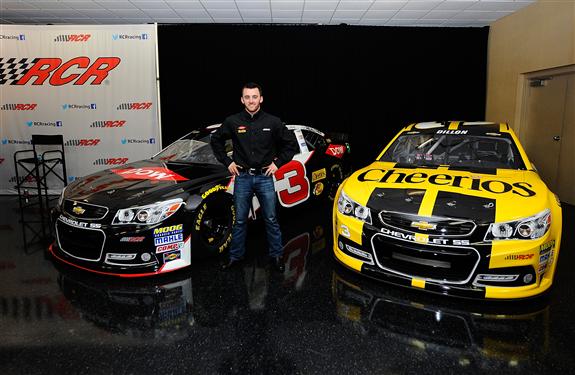
The most significant modern change to NASCAR came in the form of the “Car of Tomorrow,” a technologically advanced chassis introduced for the 2012 season. Geared towards driver safety, the CoT chassis offered a vast number of changes – a higher, wider roll cage, double frame rails and the use of protective foam, for starters. It also signaled the definitive end of the stock car as a vehicle that could win races and sell in volume at dealer showrooms.
The Rise of a Merchandising Giant
NASCAR may be all about stock cars, but that hasn’t stopped a variety of companies from joining forces with the highly successful franchise. For instance, NASCAR and Harley-Davidson came together in 2008 to create the NASCAR 60th Anniversary Motorcycle Series. The custom-built run of 60 motorcycles were individually serialized and offered for sale to the public, according to Motorcyclist Online.
NASCAR and Harley-Davidson presented motorcycle #60 to NASCAR Sprint Cup Series driver Kyle Petty, who auctioned the bike for charity during that year’s Coke Zero 400. This rare bike might be hard to get your hands on, but a fresh set of Dunlop D402 Harley-Davidson whitewall motorcycle tires at Bikebandit can help your Harley mimic the one-of-a-kind look of the 60th Anniversary Motorcycle.

Photo of Kyle Petty by APCEvents via Flickr
From t-shirts, hats and other official apparel to posters, die-cast cars and even commemorative versions of today’s most popular automobiles, the sanctioning body has amassed a merchandising empire with revenues of $645.4 million in 2010, according to figures from International Speedway Corporation.