
Amanda’s Articles
by Amanda Vincent
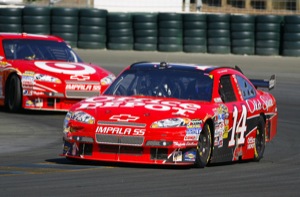 When NASCAR heads to a road course, as both the Sprint Cup Series and Nationwide Series do this weekend by traveling to Watkins Glen, many teams, especially some of those with regular drivers who, at this point, have no shot of making the Chase, turn to road course ringers to improve the team’s position in owner points standings.
But is the road course ringer route really the way to go? For some, maybe the answer is yes, especially if their regular driver is absolutely pitiful at getting around a road course. Yes, Ron Fellows has won a race here and there in both the Nationwide Series and Camping World Truck Series, but a road course ringer hasn’t won a Cup-level event since 1973 when Mark Donohue won a Cup race at the old Riverside International Raceway.
Besides, NASCAR has more than a few road course aces on its regular roster.
It’s no secret that Jeff Gordon and Tony Stewart have this whole road course thing figured out. The two drivers are tied for most all-time wins at Watkins Glen with four victories apiece. Stewart has three wins in the last five races at the Glen. He finished second in the other two.
“I’ve just always liked it (racing on road courses),” Stewart said. “I won a national championship racing go-karts on road courses, so the concept of what it took to win races on road courses wasn’t totally unknown to me, but driving cars with suspension, and definitely driving cars that you had to shift, that’s something that came relatively easy to me, and still comes easy to me as far as knowing how to synchronize the gears without having to use the help of the clutch. Even in the sports cars that I’ve driven with guys who have driven road courses all their life, I’ve gotten out of the car and the crew has torn the gearboxes apart and said that the dog rings in my transmission look better than when those guys are done with a transmission. There’s just something about the shifting side of it that’s been really natural to me, and it’s fun. I like having a different discipline to race on. I like having the opportunity to do something twice a year that we don’t get a shot at doing very often.”
While Gordon has struggled turning both left and right as of late, he has given indications of road course brilliance throughout his career. He even visited victory lane on three-consecutive visits to Watkins Glen from 1997 to 1999.
In addition to Stewart and Gordon, other series regulars are also showing signs of road course expertise. Kyle Busch swept both road course events a year ago.
You could also throw Juan Pablo Montoya and Marcos Ambrose into that mix. In years past, most of NASCAR’s stars have come from the ranks of various predominantly oval racing series, but Montoya and Ambrose both came to NASCAR with an extensive road course background. Although neither of them have been in NASCAR for very long, both have visited NASCAR victory lane following road course wins. Montoya has both a Nationwide and Sprint Cup road course victory to his credit, and Ambrose added a Nationwide road course win to his resume a year ago.
Several NASCAR regulars who don’t have a reputation as a road course ace are working on joining the club. One such driver is Carl Edwards.
“I had three goals for this season, and they were to win the championship, win at Martinsville and win a road course race,” Edwards said. “We have been getting better on the road courses and I feel when we tackle Watkins Glen and its 11 turns and banking we will be one of the cars to beat. It’s always challenging, but I really like it a lot. I’m looking forward to it and I plan on coming out of there with a very solid finish, hopefully a win.”
One name that may not come to mind when talking about NASCAR road course racing is Elliott Sadler, but even though he doesn’t have a road course win, he’s not too shabby at Watkins Glen and Infineon Raceway. As a matter of fact, in the last 10 Sprint Cup road course races, Sadler is second to Stewart in the number of points earned. His average finish over the last 10 road course events (spanning five years) is 12.3, and he’s finished on the lead lap in all 10 of those events.
“The trick is staying on the track and hitting your marks,” Sadler said of his road racing secret.
Seems pretty obvious, doesn’t it? That is easier said than done, though.
“A good road racer has to be very smooth with all car inputs – brakes, throttle, and steering,” Fellows, who is a four-time NASCAR Nationwide Series road course winner, said. “The biggest difference from an oval is the footwork approaching a corner. When you enter the corner on a road course you brake and also downshift the transmission. You’re going from the gear you are in to the gear you need. Sometimes you’ll even downshift through two gears. It can be a bit tricky as you need to match the rpm’s from the gear you’re in to the gear you need. If it goes wrong and you don’t get it exactly right, that’s when you see the dreaded rear-axle hop. That is usually followed by the back end of the car going into the corner first – never a good feeling.”
Fellows also has a Truck Series road course win to his credit.
Sure, some teams may benefit from bringing in a road course ringer for the series’ two road course events each year, especially teams that are desperate to do whatever it takes to remain in or get into the top-35 in owners points. But many teams that are far ahead of 35th seem to have the answer to road course success already within their racing stable. Considering those drivers’ familiarity with that they race pretty much every weekend, they have the advantage of familiarity — an advantage these road course ringers don’t seem to have an answer for.
The Heluva Good! Sour Cream Dips at the Glen Sprint Cup Series race can be seen live on ESPN at 1 p.m. ET Sunday.
The opinions expressed in this article are those of the author and not this website.
To read more articles by this author, including features, race previews, and post-race coverage, go to:
 The Final Lap Weekly